

4Cyte Pathology provides a SMS warfarin dosing service for certain qualifying patients. The program is only open to those patients whose warfarin dosing can be safely managed using a SMS dosing service and meet the other eligibility requirements outlined in the sections below.
Key Patient Terms and Conditions + Frequently Asked Questions
 What is warfarin?
Warfarin is a prescription medicine that helps prevent harmful blood clots. It’s often called a “blood thinner,” but it doesn’t actually thin the blood—it simply makes it take longer to clot. Doctors use warfarin to lower the risk of clots in conditions like atrial fibrillation, after some types of surgery, after a deep vein thrombosis (DVT) or pulmonary embolism (PE), and for some people with mechanical heart valves.
Your dose is individual and guided by a simple blood test called an INR. When used correctly, warfarin is very effective. The main risk is bleeding, so you will need regular INR checks and then clear instructions in relation to any required adjustments to your dose.
How does warfarin work?
- Warfarin works in the liver by blocking vitamin K from making certain clotting proteins (factors II, VII, IX and X). With fewer of these proteins, your blood takes longer to form clots—reducing the chance of a dangerous clot travelling to the lungs, brain or elsewhere.
- Because it changes the body’s clotting proteins, warfarin doesn’t work instantly. It usually takes 2–3 days to start having an effect and several days more to settle at the right level. That’s why we monitor your INR (International Normalised Ratio). Your doctor will set your personal INR target (commonly 2.0–3.0, or slightly higher for some heart valves), and 4Cyte will aim to adjust your doses to keep you safely in range.
What is the aim of 4Cyte’s warfarin dosing service?
Your family doctor remains at all times, the primary contact and reference for your medical care including warfarin dosing.
4Cyte assists your doctor by providing you and your doctor with warfarin dosing recommendations based upon your INR test result.
4Cyte dose recommendations aim to keep your INR within the prescribed target range (set by your doctor) as consistently and safely as possible, thereby preventing thromboembolism while minimising bleeding risk.
Our warfarin dosing service aims to:
- individualise your warfarin dosing based on your clinical indication, target INR, age, comorbidities, and interactions with your medications.
- monitor INR at appropriate intervals and adjust doses promptly after any out-of-range results.
- optimise time in therapeutic range.
How does the 4Cyte warfarin dosing service operate?
- Once you have been successfully enrolled in the service, your doctor will give you a referral for an INR blood test. You will need to take that referral to one of 4Cyte’s pathology collection centres for the necessary blood specimens to be collected for the INR test.
- Generally, within 24 hours of taking your blood test (but up to 48 hours later in some circumstances), 4Cyte will send an SMS to your nominated personal mobile phone with your INR result, your warfarin dose, and your next testing date.
- The dosing instruction will be sent via SMS. 4Cyte will NOT telephone you with your INR results or dosing recommendations.
- You are required to respond “Y” to the SMS with your test results and dosing recommendations within 48 hours to confirm your acknowledgement of receipt of and compliance with your dosing recommendations.
- Your response is required so that 4Cyte can verify that you have:
- received the SMS, and
- acknowledged that you will comply/have complied with the recommendations in that SMS.
- Repeated failure to respond “Y” to the SMS within 48 hours will indicate to 4Cyte that it is not appropriate for you to be enrolled in 4Cyte’s warfarin dosing service. 4Cyte reserves the right to discharge you from the service and return responsibility for your warfarin dosing to your GP for ongoing management.
- After your INR blood test, while you are awaiting the test results and your dosing recommendations, we recommend that you continue taking your usual dose of warfarin until you receive your new results.
Is 4Cyte's warfarin dosing service bulk billed?
- Yes.
- If you have a valid Medicare-eligible referral and meet the requirements for continued enrolment in the service, 4Cyte Pathology will bulk-bill to Medicare (no charge to you) the INR testing and your participation in the warfarin dosing service.
- Please note 4Cyte Pathology reserves the right to change this billing policy at any time.
Am I eligible to be enrolled in 4Cyte’s warfarin dosing service?
To be eligible to firstly be enrolled in the 4Cyte Pathology Warfarin Dosing Service, you must meet each of the following criteria:
- Be taking warfarin.
- Have direct and continual access to your own personal mobile phone in order to receive dosing instructions from 4Cyte Pathology. It cannot be a shared / third party mobile phone.
- Be competent in digital-based communications, including:
- Being able to electronically receive, comprehend and acknowledge SMS dosing instructions
- Being able to follow English language dose instructions
- Being able to correspond proficiently via email, webforms, SMS etc
- Be a resident of Victoria, northern New South Wales or Queensland.
- Be under the care of a GP who routinely refers their patients to 4Cyte Pathology.
- Be enrolled in the dosing service for a minimum period of one month.
- Be able to attend for testing on dates and intervals as recommended by 4Cyte Pathology from time to time.
- Not have been discharged from any other warfarin dosing program due to non-compliance with program rules.
- Not require a narrow INR target range (less than one unit).
- Not require daily INR levels.
- Not require acute care.
- Undertake to immediately inform 4Cyte Pathology if you no longer satisfy any of the above criteria.
What must I do to maintain ongoing eligibility for 4Cyte’s warfarin dosing service?
To be eligible to continue your enrolment in the 4Cyte Pathology Warfarin Dosing Service, you must:
- See your treating / managing doctor regularly and advise them promptly about:
- any bruising, bleeding, or illness; or
- any changes to your medicines or diet, including herbal remedies, vitamins, supplements, or weight-loss programs.
- Provide your Warfarin Registration ID at each attendance for INR blood testing.
- Complete the warfarin dosing questionnaire accurately at every INR blood test. By completing it fully and accurately each time, you share important information directly with our doctors including:
- your warfarin doses and dose dates;
- any missed / extra doses;
- any alerts; and
- any medication changes, including the dates you started or stopped them.
- Inform 4Cyte Pathology if you are planning a holiday, have a surgical or dental procedure coming up (or have recently had one), or if you’ve been discharged from hospital.
- Take your warfarin doses exactly as prescribed.
- Attend all scheduled blood tests on the date indicated by 4Cyte Pathology.
- Keep an adequate supply of Warfarin tablets, including an adequate reserve of 1 mg warfarin tablets.
- Keep your mobile contact details up to date, including next-of-kin (if needed) and ensure you are contactable via your mobile phone at any time, day or night.
- Continue to have direct and continual access to a personal mobile phone with SMS
- Be competent and proficient in use of electronic communications including receipt and acknowledgement of SMS and or email instructions written in English.
- Acknowledge by way of reply SMS your receipt of, and compliance with, testing and dosing instructions by a mobile/smart device within 48 hours after 4Cyte Pathology send a dosing instruction SMS to you.
- Maintain Medicare / DVA eligibility of pathology testing.
- Maintain professional and courteous engagement with all 4Cyte staff including collection staff.
- You will no longer be eligible for enrolment in the 4Cyte Pathology Warfarin Dosing Service if you:
- develop complex clinical conditions or become so that your dosing requirements become unstable and require one-on-one management by your referring doctor;
- require admittance to a hospital setting;
- require a narrow INR target range (less than one unit);
- require INR levels to be tested daily; or
- fail to immediately notify 4Cyte Pathology about any of the matters listed above.
This information is need by our doctors to ensure that you receive an appropriate INR dose.
- you will be discharged from the 4Cyte Pathology Warfarin Dosing Service; and
- you will need to promptly make alternate dosing arrangements with your normal treating doctor.
What if I am a resident of a Nursing Home or Aged Care Facility?
- 4Cyte does extend its warfarin dosing service to also cover INR testing and warfarin dosing for residents of aged care facilities.
- This eligibility is subject to your aged care facility’s nursing team being willing to administer and be responsible for actioning dosing recommendations.
- All other enrolment and ongoing eligibility criteria apply and remain in place
- If you are a resident of an aged care facility, your doctor remains responsible for your overall care. 4Cyte supports your doctor by performing INR tests and providing dosing recommendations. The aged care facility’s staff ensure testing and communication in accordance with instructions.
- Aged care facility staff are responsible for ensuring specimen collection on scheduled dates, monitoring resident’s medication, communicating any changes (medications, admission/discharge, health status) to our pathology service via questionnaire at time of INR testing, ensuring resident receives and actions dose instructions, and maintains records of INR results and dose.
- If you are a resident of Nursing Home or Aged Care Facility and would like to explore the 4Cyte warfarin dosing service, then please speak to your doctor and if your doctor considers appropriate, and considers that you meet the eligibility criteria, then your doctor should apply for your enrolment using the online form here.
How do I enrol in the 4Cyte warfarin dosing service?
- If you think you may be eligible for the 4Cyte warfarin dosing service, ask your doctor to consider if the 4Cyte warfarin dosing service is right for you and then ask your doctor to enrol you in the service.
- Following receipt of your doctor’s application, 4Cyte will send you an application to complete.
- Once we receive both your doctor’s and your applications, 4Cyte will assess your application and, if considered appropriate, enrol you 4Cyte’s warfarin dosing service.
What do I do if I have not received an SMS with my dose recommendations within 48 hours of getting tested?
Generally, you will receive an SMS with your dosing recommendations within 24 hours of getting your INR tested.
If you haven’t received an SMS within 48 hours of getting your blood taken, take your currently prescribed dose and contact us via:
- Phone on 13 42 98
- Email support@4Cyte.com.au
- Use the contact form at https://www.4cyte.com.au/Contact/
What are the different warfarin brands and tablets?
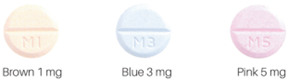
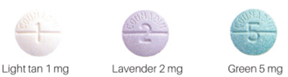
| Brand: Marevan® | Brand: Coumadin® |
|---|---|
| Strengths & colours: | Strengths & colours: |
| 1 mg — brown | 1 mg — light tan |
| 3 mg — blue | 2 mg — lavender |
| 5 mg — pink | 5 mg — green |
| Colour helps but always read the strength on the box/blister. | Coumadin tablets have the strength embossed on them (and are often supplied in blue bottles); always confirm the number on the tablet/pack, not just the colour. |
 |
 |
Important points for patients and warfarin dosing
- Take your warfarin tablet dose once a day at the same time.
- Many medicines, supplements and some foods can affect warfarin—always check with your doctor before starting anything new.
- Keep your diet consistent (especially foods high in vitamin K, like leafy greens).
- Seek urgent help if you have signs of serious bleeding (e.g., black stools, coughing/vomiting blood, severe unexplained bruising, a bad head injury).
- Warfarin is not safe in pregnancy—please tell your general practitioner if you are, or could be, pregnant.
- Stick to one brand of warfarin. If your tablets look different or the brand changes, tell us—your INR may need closer checking.
- Don’t mix warfarin tablets in pill boxes unless labelled by strength. Keep blisters/labels so you can confirm the dose.
- Never guess the warfarin dose by colour alone. Different brands/countries use different colours.
- Warfarin is only taken by mouth.
What if I am travelling or vacationing?
- If you are travelling or vacationing and you will not be able to attend a 4Cyte Pathology Collection Centre for your testing and dosing, then 4Cyte will not be able to manage your warfarin during this period.
- You will need to make arrangements in advance of your travel with your own doctor or a doctor at your destination to manage your INR testing and warfarin dosing.
- 4Cyte requires that you record your warfarin doses and dates and 4Cyte recommends that you take that dosing history with you as a reference for any doctors involved in your management whilst you are travelling.
What if I am admitted to hospital?
- 4Cyte does not manage your warfarin whilst you are in hospital.
- For 4Cyte to resume management of your warfarin after your discharge from hospital, the discharging hospital must immediately complete the online Hospital Discharge Form. This will provide 4Cyte with the information required to safely resume management of your warfarin moving forward.
- You must advise us when you are planned to be admitted and when you have been discharged from a hospital via:
- Email support@4cyte.com.au or
- Use the contact form at https://www.4cyte.com.au/Contact/
How do I manage my warfarin safely?
Here are simple steps to help keep your INR in range and your therapy on track:
- Complete the patient questionnaire at every warfarin test.
- Acknowledge confirmed receipt of SMS’d dose and testing instructions
- Use a daily pill organiser to help you take the correct dose.
- Take your dose at the same time each day.
- Follow the dose instructions from 4Cyte exactly.
- Do not stop or change your dose unless advised by a 4Cyte doctor or your own doctor.
- Stick to one brand of warfarin—don’t switch brands.
- Do not combine brands of warfarin
- If you miss a dose, do not double up. It’s safer to skip the missed dose and take your next dose at the usual time.
- Immediately tell your doctor and 4Cyte (at your next INR test) if you have any bruising, bleeding, or become unwell.
- Tell your doctor and 4Cyte (at your next INR test) about any changes to medicines or health products (including herbal remedies, vitamins, and supplements).
- Tell your doctor and 4Cyte (at your next INR test) about lifestyle changes—exercise, diet, alcohol intake, travel, or major stress.
- Inform every healthcare professional you see that you are taking warfarin.
What are the factors that can affect your INR and warfarin dose?
- Diet
- Avoid crash dieting or binge eating.
- Keep servings of foods high in vitamin K regular (small–to-moderate portions: about ½ cup, or 2–4 tbsp per serve). Foods highest in vitamin K - Leafy greens (spinach, kale, cabbage), broccoli, parsley, coriander (cilantro), alfalfa, soy products, and green tea.
- Do not cut out these foods—just keep amounts steady.
- Changing Diet
- Illness (especially nausea/vomiting or reduced intake)
- Hospital stays (in-hospital menus may differ)
- Travel (different foods and routines)
- Starting a new eating plan (e.g., weight-loss programs, meal replacements, shakes, or supplements)
- Illness: If you feel unwell, consult your doctor.
- Medications & health products: This includes prescriptions, over-the-counter items, herbal/naturopathic products, vitamins, and supplements. Check with your doctor before starting, stopping, or changing anything.
- Environment: Prolonged hot weather and dehydration can have an effect.
- Alcohol: Keep to moderate intake and avoid big changes in how much you drink. Ask your doctor what’s appropriate for you.
- Lifestyle: Changes in exercise, body weight, stress levels, and travel routines can all influence your INR.
- Medicines that commonly interact with warfarin: Many medicines can increase or decrease warfarin’s effect. Always inform your doctor and the warfarin dosing service (at time of your INR testing) before you start or stop any of the following:
- Antibiotics
- Anticonvulsants
- Anti-inflammatories
- Chemotherapy
- Painkillers (including paracetamol and aspirin)
- Most herbal medicines
- Some vitamins
- Warfarin may also be affected by treatment for:
- Arthritis
- Gout
- High cholesterol
- Peptic ulcers
- Email support@4cyte.com.au or
- Use the contact form at https://www.4cyte.com.au/Contact/
Your warfarin dose is tailored to your current eating pattern, lifestyle, and health. Sudden changes can shift your INR (your blood-thinning level). Use the guide below and always speak with your doctor before making significant changes. There’s no special “warfarin diet.” Aim for a balanced, varied diet and keep your vitamin K intake consistent. Remember:
Some situations make dietary changes hard to avoid. Please notify your doctor if any of the following occur, as your INR may be affected:
Important: If you’re unsure whether something could affect your warfarin, ask your doctor. Keeping your diet, medicines, and routines steady—and letting us know about changes—helps keep your INR in the safe range.